
Day 18: A New Song, Of Christmas Singing
Editor’s Notes: On the seventeenth day of our 2025 Advent blog series, “Visions of Visitation: Love in Motion,” DC Service Corps volunteer David Adah-Ogoh uses a Middle English Christmas carol to reflect on the fulfillment of God’s promises. In this blog, David uses the word “lullay,” a Middle English verb meaning to make soothing sounds to help a child sleep, inspired by the lyrics of “Lullay Mine Liking.”
“Mary is that wondrous union of grace and freedom, which urges each of us to have trust, courage and participation in the life of God’s people. ‘He who is mighty has done great things for me’ (Lk 1:49): may each of us know this joy and proclaim it with a new song.” – Pope Leo XIV, reflecting on the Visitation

“The Nativity,” by Eleanor Fortescue-Brickdale (date not known)
What sort of promise is a song, anyway?
Over the last two months, the Casa community has had to witness my growing enchantment with the 15th century Middle English Christmas carol “Lullay Mine Liking”. In that roundabout way many carols share, it is a carol about caroling: the narrator crosses a scene of “angels bright” singing, of “all heaven’s bliss…making sweet melody”. At its heart Mary lullays her little child, “her swete lording:”
“Lullay my liking, my dear son, my sweeting,
Lullay my dear heart, my own dear darling.”
The angels in this carol (and all in our favorites) sing in celebration for the revelation of God in human flesh. Tonight, we will too. Mary’s song here goes one step further: it is a song of comfort and trust. It suggests that we might have more to give to God than our praise, that we might dare comfort God. “Welcome to the world, my little one. Here you are safe; here you may rest. You are cared for here; close to my heart you are loved.” These songs do not contradict each other. Without them both, Christmas is impossible. For the one song draws our hearts upwards, towards the glorious blaze of a thousand, thousand, thousand stars. The other enters the taut, tentative, fleshy world of a promise. For only a body, in all its limitations, can bear a promise.
As we close this profoundly evocative season in the Church’s liturgical year, I want to look briefly to its beginning. Four Sundays ago, we heard of the children of the Earth in the days of Noah. They ate and they drank, they married and gave in marriage. As we do tonight, they celebrated. Their celebrations may have been a thing of beauty too, like ours, but before the flood, they felt no stirring for the beauty of a rainbow. They felt no need for a new promise.
I think we feel the need for a new promise more keenly than ever. We feel that need in no small part because of broken bodies: in the Gaza strip, in Ukraine, in the sweeps that terrorize our migrant brothers and sisters, on a warming planet. Though the restoration of the Covenant is a powerful prophetic theme across the Old Testament, the term “new covenant/promise” is only used once (Jeremiah 31:31-34). The covenant God promises there is written on the minds and hearts of his people, scored into their capacity for reason, beauty and connection. It is this capacity that keeps us dreaming, hoping, promising.
A carol is an experience of invitation. One posited etymology traces carol to the Latin carula: a circular dance perfect, unbroken, potentially unending. Mary ends the Magnificat with the memory of God’s promise to Abraham, a promise that she passes on to the infant Jesus, a child of Abraham: perfect, unbroken, potentially unending. What a song promises is that the life that bubbles under it, that expresses the inexpressible through it, might go on. For Mary, it is hope. For me tonight, it is my appreciation for the films of Michael Power and Emeric Pressburger.* As we raise our voices in carol tonight and in the twelve days to come, may we feel keenly the need for a new song in our souls. May we celebrate and comfort our beautiful God.
Alleluia. Emmanuel has come to us.
Questions for Reflection: Which Christmas carol resonates with you the most this year? How does that Christmas carol help you reflect on God’s promises?
*The setting of “Lullay my liking” by Richard Terry (my favorite) was immortalized in the Powell and Pressburger film Black Narcissus (1947). The Gustav Holst arrangement is also splendid.
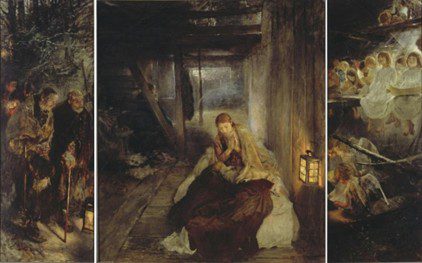
Fritz von Uhde, “The Sacred Night: A Triptych” (1888)
Tagged in:

