
See What I See
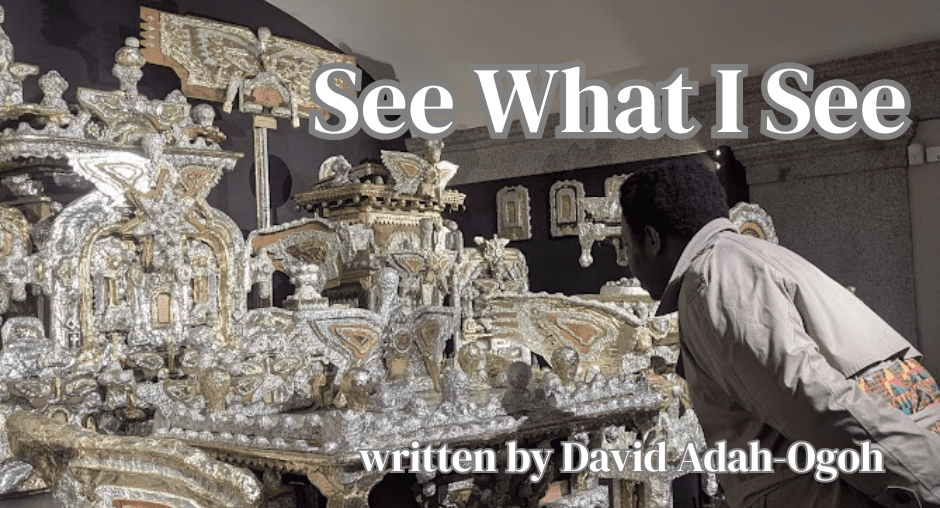
Editor’s Note: DC Service Corps volunteer David Adah-Ogoh reflects on two pieces of art while contemplating how he sees things differently during his year of service.
Pretty isn’t beautiful, Mother. Pretty is what changes—what the eye arranges is what is beautiful. “Beautiful”, from Sunday in the Park with George by Stephen Sondheim and James Lapine
What color is a sunrise? What color is a sun rising in the west? What color is a throne? What color is–should–the throne of God be?
I did not set out to write this blog with those questions in mind. When I began, one empty Saturday afternoon in early spring, I had reckoned my task would be far simpler: I would pick out two seminal works of Black art in Washington, and when I had the time, I would go and look at them until I had seen all there was to see.
Choosing the first was easy. The sculptor James Hampton lived a very small life: his greatest adventure was his service in a segregated, noncombatant unit during the Second World War maintaining airstrips in Guam and at Saipan. By his death, he had worked as a janitor in the General Services Administration for almost twenty years. What bridged these two signal events in his life was the unlettered construction of a sculptural masterpiece out of knicks and knacks and a high-backed, well-loved armchair, all done up in reams of tinfoil. Every time I have a visitor in town I take them to the National Portrait Gallery to see Hampton’s The Throne of the Third Heaven of the Nations’ Millenium General Assembly.
Choosing the second was also easy. For thirty years, the Howard University art professor and watercolorist Lois Maillou Jones lived and painted across the street a few doors down from Casa San Salvador. Her house no longer stands, but the city loves her art. (Eighteen of her paintings are owned by DC-area museums.) Yet, on the Saturday I decided to go, only her 1940 piece Indian Shops at Gay Head, Massachusetts, was on display locally, at the National Gallery of Art. That settled it: the NGA is an eleven-minute walk away from the NPG. I planned to spend as much time there as the paintings (and the museum staff) permitted.
Indian Shops is yellow. Where the sea and the sky become one there is only a streak of yellow. The footprints dappling the sandy beach are a dark yellow. A wigwam towers in the foreground of the painting, a rich yellow against the morning. It is the yellow that convinces me that it is morning in the painting: the heavy brushstrokes Jones uses for her clouds are tinted with it. I had a friendly argument with the docent about it (yellow, he thinks, is the color of sunset; I think pink). Throughout the painting, Jones implies that there are holidaymakers present: a lone sailboat speeding toward the horizon, the footprints in the sand, a shop to tend. In that implication she draws our eyes to the Wampanoag shopkeepers, alone in their shop, deep in conversation. Gay Head is in Oak Bluffs, one of the only points on Martha’s Vineyard open to the Black middle class during the Jim Crow era. For a moment, the peace of the beach is hers and the shopkeepers.
The modal reaction to The Throne of the Third Heaven is “What is that?” However you approach it in the gallery it overwhelms you—a storm of spheres, wings, stars, crowns, tablets, great bulbous keys. Visitors take pictures, stare at it, scoff at it, trying to comprehend/circumscribe it. As I looked among the throng, I kept coming back to the top of the throne, where Hampton has his most direct message: FEAR NOT. The throne greets as the angel Gabriel greeted Mary; what tidings might the Throne bear to its viewer? In my eyes, I saw a successful failure: Hampton was a very small man who threw himself into making a gift that seated God’s majesty. He died before the Throne was finished; I do not think it ever could have been finished. But that a Black janitor during Jim Crow—lowest among a people that a country had slotted into its lowest possible rank—would reach up to the Third Heaven (2 Corinthians 2:12-14) and try to bring the wonder of it down to earth? Dare we hope in that way?
Much of my time in service in DC has been wrangling with the question of how, what, and whom I see. When I put on my headphones and brush past an unhoused neighbor at the Metro stop, what am I refusing to see? When I speak on the phone with a discerner about the work my housemates do in their placements, what am I helping them see? I let myself see so much in forty-five minutes apiece with two extraordinary artists at different poles of midcentury Black life in Washington. Perhaps this inspires you to see differently.
Question for Reflection: When has something or an experience helped you see things differently?

The author ponders “The Throne of the Third Heaven.”
Tagged in:

