Hope, Fear, and Evangelical Fraternity
Editor’s Note: Lay missioner Mary Liston Liepold, OFS shares her reflections on “Reimagine El Paso,” a conference with Bishop Seitz and El Paso Interreligious Sponsoring Organization (EPISO) which fostered open dialogue about pressing issues faced in the region. Mary also shares how her time on mission serves as a starting point for change.
El Paso, Ciudad Juárez, October 14, 2025
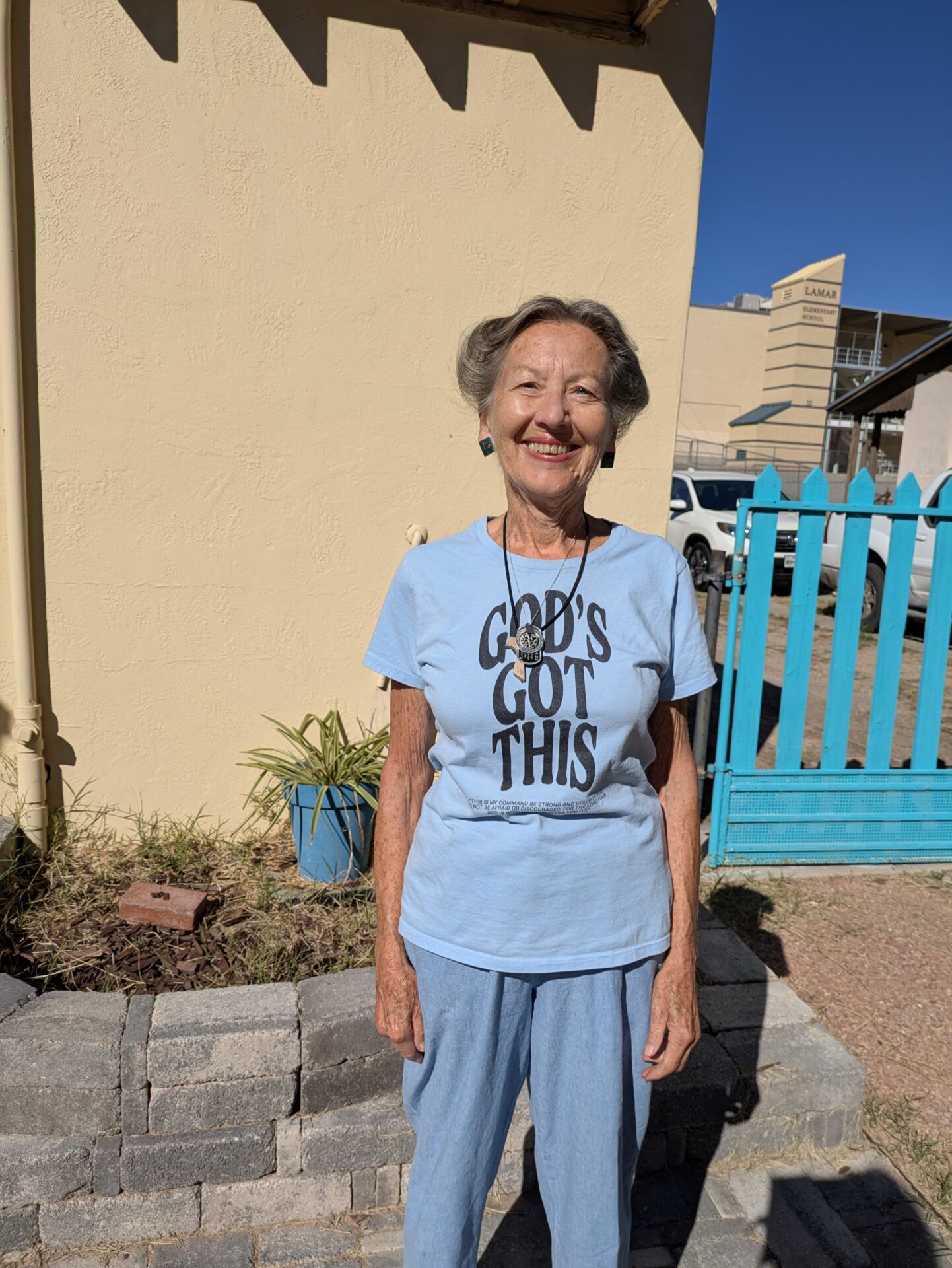
Mary saw this shirt on a woman in a restaurant and it rang so true that she ordered one to remind herself.
I just spent a day and a half learning from El Paso’s Bishop Seitz—Pax Christi International’s 2025 Peace Award recipient—and EPISO, our local Industrial Areas Foundation (IAF) community organization. Though my days here are always a mixture of grief for the state of our common home and gratitude for the beautiful people I share it with, I am feeling both with exceptional intensity right now.
Migration was one of five key issues at Sunday afternoon’s Re-Imagine El Paso, where 660 EPISO stakeholders focused on the city’s major concerns. Re-Imagine Migration, on Monday, included scores of IAF leaders from across the West, Southwest, and Midwest. Bishop Seitz shared the video created specifically for Pope Leo’s October 8 meeting with an El Paso delegation and recounted their heartening visit. The speakers, including four other bishops who have shown national and international leadership, like San Diego’s Michael Pham and Denver’s Auxiliary Jorge Rodriguez, shared both painful stories and positive, creative action ideas.
Some actions are modeled on earlier civil rights struggles, like the 21st century Freedom Schools that ONE LA is holding. In less than a year they have formed and informed 1,000 leaders. Some engage unlikely partners, like ACTION in Tulsa. They’re working with the local opera on a production of The Sound of Music that highlights the Von Trapps’ refugee status. Like the helping community here, the most successful ones elsewhere approach everyone as a potential ally, including local officials and the ICE agents themselves.
By the end of that second day, I was inspired and also sobered. I knew what was happening here—and the borderlands are unique in many ways—but I hadn’t seen quite as clearly how the same fear, loss, and muscular hope are growing day by day, from coast to coast. Nor had I imagined all the long-term impacts of today’s racist detention and deportation campaign.
I knew that new concentration camps—I refuse to call detention centers anything nicer—are strategically sited in remote, low-income areas that lack fine schools, healthy health care systems, and many other opportunities for human flourishing. (They do have congregations, which is why IAF has been successful for 85 years and still has room to expand.) Communities welcome the spending these installations create and even the dehumanizing jobs, especially as AI, automation, and shrinking public services increase unemployment nationwide.

A door in Juárez that reads “Let’s be better humans.”
What I had not considered, until one speaker pointed it out, is that even if America comes to its senses in a few years and changes course on migration, these enormous camps will have become economic mainstays. Another group will provide the target, and states will continue to over-incarcerate—in this nation that already holds more prisoners per capita than any except El Salvador, Cuba, and Rwanda. The prospect chills my blood.
I love our country and our world, and I will not live to see healing for the wounds to the Body of Christ that are being inflicted today. Yet, I continue to hope because I know I am not alone. I have human allies AND I am a tiny part of God’s perfect plan for the universe.
In paragraph 104 of his new apostolic exhortation, Dilexi Te (I Have Loved You), Pope Leo describes our walk with the poor as “striving to transform their situations, starting from them.” The bold emphasis is mine, because it reminds me to start with the people I see every day. I can choose my starting point and leave the ends in God’s hands.
I can start with the children in Juarez who teach me Spanish while I try to teach them English. With the five-year-old girl I draw, pretend, and work puzzles with while her mom takes a parenting class. With the Opportunity Center residents whose stories I listen to while I help them select new used clothes. With the people I greet on the street every day—or the man I smiled at, sadly, and blessed this afternoon as he left the courtroom, before seven (!) ICE agents grabbed him and took him away.
As children of God and heirs of the Good News, we are all sisters and brothers. “Francis did not found a social service organization,” Pope Leo writes in paragraph 104 of that letter, “but an evangelical fraternity.”
Question for Reflection: Where is your “starting point” to transform the lives of your sisters and brothers?
Mary invites you to learn more about the big picture of detention, deportation, and resistance by reading this account Scott Wright developed for Pax Christi USA: https://paxchristiusa.org/2025/10/10/pax-christi-usa-stands-in-solidarity-with-immigrants-to-challenge-campaign-of-terror/.
Tagged in:

